| |
Every since my wife and I planned our own interfaith wedding, I’ve been fascinated by how beautiful these ceremonies can be.

Subscribe to this blog
I recently read a post by the bride Diorable as she described how she was planning her interfaith wedding. She talked about how they were choosing the traditions they would have in her ceremony, to make it fit the personality and beliefs of her and her fiancé. As she described it: “This isn’t a sundown thing with a ketubah. We are absolutely cherry picking.”
I applaude Diorable’s creativity and drive to create a ceremony tailored to them. The whole point of the wedding is that it is a ceremony of two people coming together as one, and it therefore needs to reflect who those two people are.
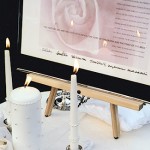
“Cherry-picking” traditions is a common way to construct an interfaith wedding ceremony. When my wife and I were planning our wedding, we also cherry-picked different aspects of our combined Jewish and Catholic traditions for our wedding. This let us honor our traditions, while defining our own combined values. We had two friends sing a modern version of the Seven Blessings. Another friend read an updating translation that I wrote of the famous Corinthians passage “Love is patient, love is kind”. We stood under a huppah as my cousin the priest and our rabbi both gave their blessings. We lit a unity candle, then stomped a glass. Some might find this kind of ceremony a little crazy or inauthentic, but we loved it — it fit us perfectly. It wasn’t a Jewish wedding, it wasn’t a Catholic wedding — it was our wedding.
And of course, even aspects of a ceremony that are considered “very traditional” can be modernized and updated to fit your personality. The ketubah is a perfect example. Many people might still assume that having a ketubah automatically makes a wedding very Jewish or very traditional (as Diorable described it “a sundown thing”). But not any longer. Most of the ketubahs I create are for interfaith and multicultural couples. They decided to add this tradition to their ceremony, but didn’t want it to feel overly “traditional”. So they made a ketubah that is modern, inclusive, and very personal.
In our wedding, our crazy combined ceremony worked to bring our two families together in a beautiful and special way. Each side could relate to part of the ceremony, and share the experience of something new. We explained the traditions throughout the ceremony, in simple terms, so that everyone could appreciate the parts they weren’t familiar with. We worked carefully with our rabbi to make sure the ceremony came together as a whole, and that no one felt left out, or confused. And in the end, our families loved it as much as we did. It was as much a celebration of our new marriage, as it was of our families and traditions that helped make us who we are.
Update 2010-03-01: On the blog Fifty Percenters, PrincessMax shared the details of the thoughtful wedding program she created for her interfaith wedding. It is a great example of how you can explain all of the elements of your ceremony to your family and guests, so that they all feel a part of the celebration.
When you are planning an interfaith wedding, it’s a good idea to provide an explanation of the different traditions in your wedding program. This gives everyone the chance to understand the meanings behind the traditions you selected for your wedding. Plus, it makes both sides of the family feel welcome and included in the ceremony. One of my couples shared with me the text they used in their program:
The Ketubah is the Jewish marriage contract, outlining the responsibilities of the bride and the groom. The Ketubah confirms that Andrew and Joanna willingly accept each other and assume obligations to one another. One of the oldest elements of a Jewish wedding, the Ketubah dates back over two thousand years. Today, most Ketubot (plural form of Ketubah) are spiritual, not legal, covenants that the bride and groom make with one another. Prior to the wedding ceremony, Andrew, Joanna and the Rabbi signed the ketubah in the presence of two witnesses, family and friends.
During an interview, Star Trek (and Lost) director J.J. Abrams had this to say about interfaith marriage:
My wife is Irish Catholic and it’s a fascinating thing having married someone who’s of a different religion, because you get to understand and see and respect another way of growing up and believing. That to me is interesting and healthy.
I always say interfaith couples have a deep understanding of religion’s place in their lives. A same-religion couple can (often erroneously) make the assumption that they share the same traditions and beliefs. But an interfaith couple cannot make any assumptions. They have to talk about how they were raised, what they believe, what they are unsure of. They have to think how they want to raise their kids, and celebrate the holidays. The have to figure out how to talk about family, heaven, sin, faith, God. They have to talk, they have to discuss, and more importantly, they have to make decisions about all this as a couple. This ongoing conversation makes them, their family, and their faith stronger.
One thing I have learned is that every ketubah is unique. Each one takes on the personality of the couple who make it, through the design they select, the words they choose. Watching each couple craft a ketubah that reflects their personality is one of the things that make my job as a ketubah artist so interesting.

One couple, Krista and Matthew, just came to me with a unique and fun request. They are an interfaith couple, Catholic and Jewish. So they wanted the text of their ketubah to reflect both of their traditions. But their idea was to not just do this through the words they used, but through the languages used as well. Just like Judaism is grounded in its use of Hebrew, Catholicism is rooted in Latin. Although it is not used anymore for regular services, the language is still a part of the flavor of Catholic culture. Krista and Matthew wanted their ketubah to respect both of these linguistic traditions. So we created a ketubah that blended English, Hebrew and Latin. Luckily Krista had an aunt who knew enough Latin to provide a translation! The result was quite special, and very much reflected the personality of Krista and Matthew.
Interfaithfamily.com and Rabbi Steven Carr Reuben have put together a short video that gives interfaith couples some good basic advice when getting ready to plan their weddings. They say that this is the first in the series, so we look forward to seeing the rest.
Kim and Matthew wrote to me to describe why they chose my Autumn Gold ketubah, and to describe how they customized their interfaith wedding ceremony to fit their personalities:
“One reason we chose your artwork is that my fiancé very much likes Japanese décor. We have created a “flower ceremony” within our ceremony during which we are exchanging five flowers with specific meanings to give each other for the recipe for a great marriage. Specifically, we are using the Lotus Flower because it blooms in tough times, the Lily of the Valley which means happiness, the Chrysanthemum which means love and longevity, the Yellow Rose which means friendship and finally Ivy which means Fidelity. The Japanese Maple Leaf that we found on your website was yet another aspect of the Japanese decor and fit our theme perfectly! The moment we found your website we knew it was perfect.”
In addition to their wonderfully unique “flower ceremony”, Kim and Matthew chose to sign their ketubah during the wedding ceremony, instead of before (as is tradition). They also added two extra witness lines so that both the bride and the groom could choose two people close to them to sign it.
Modern Ketubah is proud to now offer interfaith couples three new texts written specifically for them. I have written these new texts to honor how an interfaith marriage represents the coming together of two traditions, a merging of two different families into one new, stronger one. Here are a sample of what each new Interfaith text says:
- Interfaith 1: “Our lives are now forever intertwined. Our similarities will bind us, our differences will enrich us, and our love will define us.”
- Interfaith 2: “We approach this ketubah as two individuals with different backgrounds and individual lives, but shall leave it as one couple, one family, joined in love and commitment to each other.”
- Interfaith 3: “We will create a home built on the foundations of our traditions, and nurtured by the values of our families.”
Learn about all of the options you have available for your interfaith ketubah. To read these new texts, visit my page on text options for your ketubah and choose Interfaith 1, Interfaith 2, or Interfaith 3 from the menu for English texts.
Modern Ketubah is proud to now offer interfaith couples new choices to better customize their ketubahs. Each of my ketubah features a large poetic verse incorporated into the design. These verses usually come from Jewish tradition, such as “Ani l’dodi v’dod li” (I am my beloved’s and my beloved is mine), which a very popular phrase for Jewish weddings which comes from the Song of Solomon.
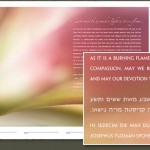
To help interfaith couples make their ketubah more inclusive of both of their traditions, I have added a number of new poetic verses from a variety of non-traditional and non-religous sources, including Aristotle, Thoreau, and Ghandi. Through these words, any couple should be able to find a sentiment that best expresses what their ketubah means for them:
- Love must be as much a light as it is a flame (Henry Thoreau)
- Life is the flower for which love is the honey (Victor Hugo)
- To live without loving is not really to live (Moliere)
- Where there is love there is life (Gandhi)
- Love is composed of a single soul inhabiting two bodies (Aristotle)
These verses can be added to any of my designs. To see all of the verses available for your ketubah, visit my page on options for your ketubah. If you have a suggestion for another verse, please let me know.
For anyone who is orthodox, and is also in an interfaith relationship, I highly recommend the article “Orthodox Paradox” written by Noah Feldman for the New York Times Magazine this past weekend. He describes his love and connection to his community, and his sadness at their not being able to accept his choice for a wife. The Jewcy online magazine has an interesting Q&A follow-up with him. When asked why he was surprised that his yeshiva cropped him and his non-Jewish girlfriend out of a reunion photo, Feldman responded:
What is troubling about the view you describe—which I never sensed from my classmates—is its implication that somehow modern Orthodox people should be protected from my living my life as I choose…. People who are comfortable with their own life choices don’t get “offended” when others choose differently.
There’s an interesting article in the Jewish Week, called The Other Kind Of Mixed Marriage. In it, Abby Schachter talks about how every marriage can be classified as a mixed marriage, since no two people share the same religious background:
The fact is that Jewish life in America is so varied, and each person’s Jewish experience is so different, that it almost seems as if every Jewish marriage is an intermarriage.
I wholeheartedly agree. I believe that in some ways interfaith couples have it easier that same-faith couples because they know up front that they will have to discuss their religion and explain their traditions. While same-faith couples often assume that because they are both Jewish or both Christian, that they share a lot of the same beliefs, traditions, and attitudes. But this isn’t true. Everyone has a their own unique set of beliefs and priorities. People belong to different denominations, different regions of the country have different attitudes, and every family defines their faith in different, personal ways. Same-faith couples need to take a lesson from interfaith couples, and realize that getting married means they are combining two very different sets of beliefs. Marrying someone from a different religion forces you to reconnect with your own traditions, examine your long-held assumptions, and try to determine what is really important to you. Same-faith couples need to go through this same journey of discovery together.
Related articles:
see older posts »
|
|