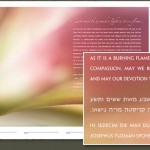
Modern Ketubah is proud to now offer interfaith couples three new texts written specifically for them. I have written these new texts to honor how an interfaith marriage represents the coming together of two traditions, a merging of two different families into one new, stronger one. Here are a sample of what each new Interfaith text says:
- Interfaith 1: “Our lives are now forever intertwined. Our similarities will bind us, our differences will enrich us, and our love will define us.”
- Interfaith 2: “We approach this ketubah as two individuals with different backgrounds and individual lives, but shall leave it as one couple, one family, joined in love and commitment to each other.”
- Interfaith 3: “We will create a home built on the foundations of our traditions, and nurtured by the values of our families.”
Learn about all of the options you have available for your interfaith ketubah. To read these new texts, visit my page on text options for your ketubah and choose Interfaith 1, Interfaith 2, or Interfaith 3 from the menu for English texts.
Modern Ketubah is proud to now offer interfaith couples new choices to better customize their ketubahs. Each of my ketubah features a large poetic verse incorporated into the design. These verses usually come from Jewish tradition, such as “Ani l’dodi v’dod li” (I am my beloved’s and my beloved is mine), which a very popular phrase for Jewish weddings which comes from the Song of Solomon.
To help interfaith couples make their ketubah more inclusive of both of their traditions, I have added a number of new poetic verses from a variety of non-traditional and non-religous sources, including Aristotle, Thoreau, and Ghandi. Through these words, any couple should be able to find a sentiment that best expresses what their ketubah means for them:
- Love must be as much a light as it is a flame (Henry Thoreau)
- Life is the flower for which love is the honey (Victor Hugo)
- To live without loving is not really to live (Moliere)
- Where there is love there is life (Gandhi)
- Love is composed of a single soul inhabiting two bodies (Aristotle)
These verses can be added to any of my designs. To see all of the verses available for your ketubah, visit my page on options for your ketubah. If you have a suggestion for another verse, please let me know.
For anyone who is orthodox, and is also in an interfaith relationship, I highly recommend the article “Orthodox Paradox” written by Noah Feldman for the New York Times Magazine this past weekend. He describes his love and connection to his community, and his sadness at their not being able to accept his choice for a wife. The Jewcy online magazine has an interesting Q&A follow-up with him. When asked why he was surprised that his yeshiva cropped him and his non-Jewish girlfriend out of a reunion photo, Feldman responded:
What is troubling about the view you describe—which I never sensed from my classmates—is its implication that somehow modern Orthodox people should be protected from my living my life as I choose…. People who are comfortable with their own life choices don’t get “offended” when others choose differently.
There’s an interesting article in the Jewish Week, called The Other Kind Of Mixed Marriage. In it, Abby Schachter talks about how every marriage can be classified as a mixed marriage, since no two people share the same religious background:
The fact is that Jewish life in America is so varied, and each person’s Jewish experience is so different, that it almost seems as if every Jewish marriage is an intermarriage.
I wholeheartedly agree. I believe that in some ways interfaith couples have it easier that same-faith couples because they know up front that they will have to discuss their religion and explain their traditions. While same-faith couples often assume that because they are both Jewish or both Christian, that they share a lot of the same beliefs, traditions, and attitudes. But this isn’t true. Everyone has a their own unique set of beliefs and priorities. People belong to different denominations, different regions of the country have different attitudes, and every family defines their faith in different, personal ways. Same-faith couples need to take a lesson from interfaith couples, and realize that getting married means they are combining two very different sets of beliefs. Marrying someone from a different religion forces you to reconnect with your own traditions, examine your long-held assumptions, and try to determine what is really important to you. Same-faith couples need to go through this same journey of discovery together.
Related articles:
Bryan and Julie are an interfaith couple who are writing a blog about planning of their interfaith wedding. If you are planning your own interfaith ceremony, I suggest you check this out. Their story will give you a perspective on some of the issues and decisions one couple went through, such as: