In this blog I discuss what goes into creating fine art wedding ketubah, as well as ideas about wedding ceremonies and traditions, and answer some of the questions and comments from the couples I've worked with. Learn about the artist Daniel Sroka and Modern Ketubah.
I recently wrote about inspiration on my fine art photography blog, and the comments there got me thinking some more on the subject. “Inspiration” is usually defined as the ideas that initiate the creativity. And I do experience this form of inspiration. But oddly enough, I have learned that it is not really a productive start to creating art.
This regular sort of inspiration comes at me all the time. And if I let it, it can quickly become overwhelming. When I open myself up to inspiration, I get bombarded: ideas, plans, brainstorms come at me from every angle… to the point that I get nothing started. I spent years of my life wanting to be an artist, yet going nowhere because I could never settle on one thing. Drawing? Writing? Sculpting? Animation? I dabbled with it all and never got off the ground.
The word “inspiration” comes from the Latin meaning “the act of breathing in”. And I found that the act of breathing in can often lead to hyperventilation — too much intake with no benefit. I have learned that if I want to accomplish anything, I need to quiet those voices of inspiration. I need to focus, limit myself, and slow my “breathing”. This is why for the past decade, I have created so many pictures of one seemingly limited subject: simple objects from nature. This simple, “limited” subject has allowed me to quiet the flood of ideas that normally pour in. Focusing myself on one creative task, ignoring inspiration, has allowed me to settle down. To stop dreaming about being an artist, and to get to work and actually become one.
Now I have to admit, working this way is not as fun. It’s slow, hard work, often with little progress. You miss this thrill that comes from blindly following a burst of inspiration. But I know from experience that that thrill evaporates quickly, often leaving me stranded. So while ignoring those flushes of passion and just plugging away isn’t as romantic… my god, the results! The results may be slower to come by, but when they do, they are so much deeper and more real.
This is when the real inspiration hits. I’ll be working on a new leaf, plugging away for days or weeks, getting sick and tired of staring at this dried, decayed thing, when suddenly…. I notice some tiny thing. I feel a hit of adrenaline and look closer, barely breathing to not disturb anything. Yes, there it is! The adrenaline changes to excitement, and the excitement generates a flood of ideas. And, by working slow and being patient, I have found the real inspiration I was looking for.
I want my ketubah to be displayed under the chuppah and have the rabbi read it aloud during the ceremony. But how do I protect the ketubah during the ceremony?
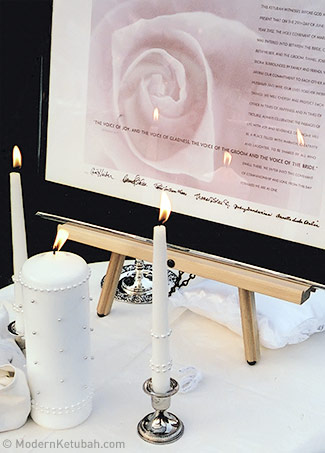
To keep your ketubah safe, you want to frame it as soon as possible. But you need it open and accessible for your signing ceremony. So what do you do? I recommend that you purchase a simple poster frame to temporarily protect your ketubah during your ceremony. This is a simple frame made of a sheet of plexiglas and a backing board that are held together with plastic clips that run down the side. They are inexpensive, available in many different sizes, and available in most art and frame shops.
I recommend that you place the ketubah in the frame before your wedding day — this will keep it flat (especially since most ketubahs get shipped rolled) and safe. It also makes it easy to transport to the place of your wedding. At the beginning of your signing ceremony, simply unclip the plexiglas and place it aside. Once your ketubah has been signed (and mazel tov, by the way) have one of your wedding party reframe it and bring it down to the chuppah. Use an easel at the chuppah to make sure that your ketubah can be seen by everyone, and is easy for your rabbi to grab when it is time for him to read it. The easel and frame also make it easy to display your ketubah during the reception, keeping it flat and safe from fingerprints and accidental champagne spills.
Another benefit of this frame? It makes the ketubah hard to lose! I have had several customers ask me to reprint their ketubah after it got lost during the wedding reception. A large framed piece of art is much harder to misplace than one stored in a shipping tube.
This month I had the honor to be one of the first artist-in-residence at the prestigious Miraval Arizona Resort in Tucson. My art has been displayed at the Resort for a couple of years, and they just launched this program to let their guests get a deeper understanding of the artwork they display. I was honored to be a part of it.
I have always felt that my work has a strong affinity to resorts and spas, especially ones like Miraval that place so much focus on your emotional well-being. To my surprise, Miraval shared an even deeper connection to how I create my art. Everything at Miraval revolves around the idea of being “mindful”. Every class and activity is designed to help you become fully aware, fully present in the moment. And as I worked on my art each morning, I realized that “mindfulness” is also the foundation for my own artistic process.
Each work of art I make, whether I am in the desert or my studio at home, starts with me being mindful of the natural world and my relationship to it. I disconnect the analytical side of my brain, and quiet the chatter in my head. I try to calm the brain’s reflexive need to process and categorize, and just allow myself to absorb what my senses perceive, unfiltered. Even when I am out gathering subjects to photograph, I cannot worry about the past or plan for the future: I have to just be aware of the present, and experience my environment as openly and simply as possible. Only then do the ideas and images come to me. In a way, my art has become my own form of meditation or prayer, helping me be more mindful, more present, more centered.
I just received this note from Betsy and Peter, a wonderful couple with a wonderful story:
We received your beautiful Ketubah and it’s wonderful. Thank you ever so much. Betsy had asked that I write you and provide feedback as to why we chose “non-traditional” artwork for our Ketubah. Maybe it’s because we’re a bit non-traditional (I’m Jewish, Betsy is not). Maybe it’s because of your fabulous uber bokeh-laden macro-photographic masterpieces of nature.
I just love that description of my art! “Fabulous über bokeh-laden macro-photographic masterpieces of nature.” If I was a 60’s rock band, I’d make that the title of my next album.
When Betsy first found your site after we were engaged* a year ago I looked at it and immediatley said, “Perfect”. I looked at the various text options and we both chose the one we did because we felt it said so much about us. That plus choosing one of your many magnificent photographs made it a most wonderful certification of our commitment to one another that we are proud to hang in our home.
You also made a fan of our Rabbi, who was totally blown away and will most likely recommend your site to the many couples who seek him out.
I aslo loved the story of how they got engaged, with its particularly modern twist:
The short story: she and I were best friends in high school but had never dated then lost touch for 39 years. Last year, both divorced, we found one another via Google and the rest is history.
Ah, the romance of the internet! I wish them both all the happiness they can handle and then some.
This is from Alan and Kari, who chose my African Lily Ketubah:
“Thank you for all that you have done. We chose this design because it is modern, and it honestly is a great piece of art that we are thrilled to hang in our house. It is not just a ketubah but truly it is artwork.”
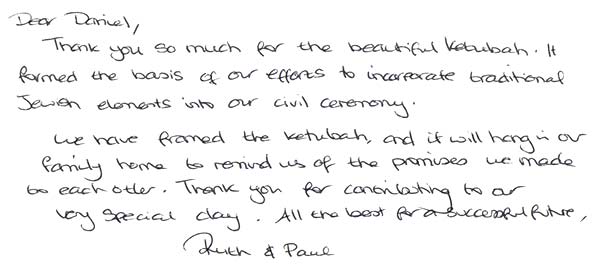
It is always wonderful to hear from my customers, especially when they take the time to send a personal note. I love how Ruth and Paul perfectly expressed the meaning of the ketubah, as both a part of there ceremony, and as a part of their lives together:
“Thank you so much for the beautiful ketubah. It formed the basis of our efforts to incorporate traditional Jewish elements into our civil ceremony. We have framed the ketubah and it will hang in our family home to remind us of the promises we made to each other.”
This guest post was written by wedding photographers Jennie and Dave of Strawberry Road. We met on Third Tribe, an online forum for entrepreneurs, and struck up a conversation. I have guest blogged for them about creating interfaith wedding ceremonies (here and here) and am happy to be able to offer you some of their deep experience on how best to work with your wedding photographer.
Disappointment is something that is rather intangible, or so I thought. While taking a class on management I learned there is a very simple way to express it as a formula. When expectations meet gratification then disappointment doesn’t arise. Conversely, if those two notions of expectation and gratification don’t meet, then blood pressure will rise, and in the case of wedding photography, there will be angry mothers and fathers and bridesmaids that wish they were somewhere else besides your wedding! Dan asked us to write a little something about working with your wedding photographer. I took the angle of ‘working with your wedding photographer to get the images you want!’ After all, the final product is really what it is all about; great images makes for a happy bride, a happy mother, etc. So what can a bride and groom do to make working with the photographer a fulfilling and productive experience?
(1) The process starts before you’ve actually hired your photographer. Don’t hire a photographer simply based on their portfolio! If you love their work and they come off as a drill sergeant to you, you don’t have to guess how your wedding images will come out! Find someone with whom you click. Chemistry is key here. If you don’t like the person taking your picture, more than likely it will show up in your images.
(2) Often times we see brides with expectations of great things from us as photographers. For example a bride may envision a gorgeous sunset shot of she and her new husband. Well, if things are timed such that she and her hubby are on the interstate between the church and the reception during sunset hours, that shot simply can’t happen. Plan ahead, plan contingencies! One wedding Jennie and I shot had us shooting the bride and groom under a lovely gazebo adorned with wild roses running up wood trellises. When we arrived with the couple at the gazebo, we found that city funding to rehabilitate the structure came in a week early and it was torn apart for reconstruction! The bride was a shambles for the next few minutes while Jennie and I scouted for alternatives. We ended up getting some fantastic shots around the park using fountains and gardens, but it was definitely hard for the bride to change her vision of her images mid-day.
(3) Every bride has a list of shots that she desires, a myriad of groups and assortments of people, different locations, fun shots, formal shots, etc. When you look at the list of ‘desired shots’ you hand to your photographer, be realistic. We’ve seen lists as high as seventy-five group shots for a wedding. A great photographer could get all those shots and do it very well if all the people needed for posed photos were lined up, prepared and being absolutely silent. Sounds easy on paper, but then with a wedding, there’s one issue a lot of brides overlook…there’s a wedding/reception going on. People are seeing each other for the first time in years, meeting new people and often times, they’re drinking. The frustration level for photographers usually peaks at this point. We lose our voices, get exhausted chasing people down, and sometimes even frustrate guests as we pry them from conversation, all the while maintaining our composure and ‘going with the flow.’ It would be amazing if you, the bride, informed people of the posed shots you expect them to participate in before the wedding day. After all, if people know beforehand what is expected of them, it is much easier to meet their expectations.
Working with your photographer should be fun. It makes for a more relaxed atmosphere, better creativity and better images. Talk with your photographer about what you expect. Not just what you expect with regards to images, but how the day will flow, etc. Go over times and locations in detail. Let the photographer know where you can be more flexible if time gets tight. Having the little things hashed out before your big day will allow everyone to be more relaxed and provide you with the best images possible. As photographers and business-people, we are constantly trying to make expectations meet or exceed your level of gratification. Communication is probably the most crucial aspect of getting there.
Strawberry Road is a fun and quirky wedding / boudoir photography company co-owned by Jennie and Dave. They’re friends that work very well together. Dave is technical while Jennie is more ‘feel’. Jennie works on a Mac and Dave works on a PC. He drinks coke products while she drinks pepsi, but together they shoot with Canon equipment. They can be found on their website or Facebook.



 (1) The process starts before you’ve actually hired your photographer. Don’t hire a photographer simply based on their portfolio! If you love their work and they come off as a drill sergeant to you, you don’t have to guess how your wedding images will come out! Find someone with whom you click. Chemistry is key here. If you don’t like the person taking your picture, more than likely it will show up in your images.