| |
In this blog I will discuss what goes into creating ketubot, ideas about wedding ceremonies and traditions, and answer some of the questions and comments from the couples I've worked with. Subscribe to this blog 
It is important for everyone to do their part to help preserve our environment. As a small business owner, I work hard to make sure that my business’s carbon footprint is as small as possible. Here’s some examples of how I run a green business:
- My studio in based in my home. I only have to go upstairs to get to work. Since I have no commute, I don’t generate any extra carbon emissions.
- My ketubah store is online and my ordering and proofing processes are completely digital. This ensures quality while minimizing paper waste.
- I actively recycle any paper I do use, as well as all of my used ink cartridges.
- I print my ketubahs individually for each customer, instead of printing them in bulk from a large printer company. This means I am not generating huge amounts of paper waste or consuming tons of excess energy.
- I only print my ketubahs on the highest quality 100% cotton-rag paper. Unlike paper made from tree pulp, cotton is an easily renewable resource. I also only select paper that does not use any artificial brighteners or chemicals. These chemicals not only pollute the environment, they can harm the archival quality of the paper.
I also hope that my artwork, which celebrates the beauty of nature, helps encourage people to respect and protect our natural environment. If you have any questions about my green business policies, please let me know.

I’d like to introduce to you two new ketubah designs I have created: the Evergreen Ketubah and the Sun Daisy Ketubah. Both of these modern ketubah designs are available in two sizes, and can be fully customized with any combination of my English and Hebrew texts and design options.
I created the Evergreen Ketubah from an abstract photograph I took of the needles on a pine branch. The soft green colors and patterns makes for a wonderfully modern, yet natural design, perfect for fall or winter weddings.

I created the Sun Daisy Ketubah from a macro photograph I took of a gerbera daisy. This photograph was one of my first experiments in macro floral photography, and is still one of my favorites. The petals of the flower gracefully open upwards, catching the light.
Sometimes, my best designs are directly inspired by my customers. Marissa and Robert were browsing my fine art photography website, and had fallen in love with this photograph. Marissa really wanted it for her ketubah: “I absolutely love it and those are actually going to be the colors of our wedding,” she told me. That was all the inspiration I needed! I was glad to be able to create a very special ketubah for her, and also have a new design I could offer everyone else.

Lindsey, a new customer, was just telling me why she and her fiancé chose my Center Ketubah, based on a photograph I took of a rose:
My future husband has a thing for roses. He has about 12 different rose bushes growing at our house in Denver. So when we saw your rose ketubahs, we knew we had to get it!
I love this! First of all, it’s an honor to have one of my photographs of a rose selected by a true rosarian. But their story also reminded me of my own:
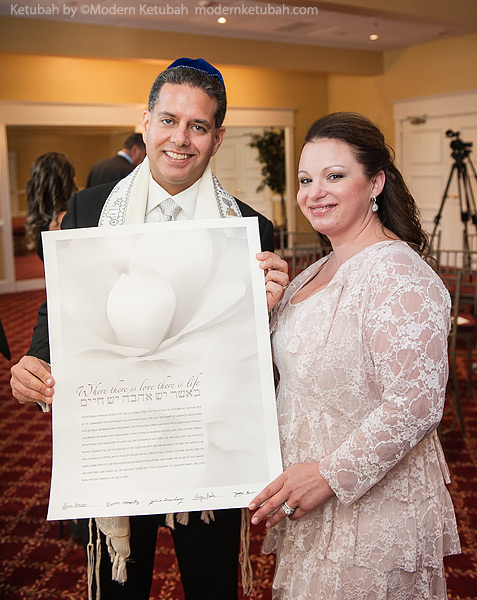
The rose in the ketubah they chose is actually the same rose that I photographed for my own ketubah that I made for my (then) fiancée and I. We had just moved into an old bungalow in the suburbs of San Francisco. Most of the landscaping was a mess, but on the side of the house was this craggy, ancient rose bush. It had definitely seen better days, and was looking rather bedraggled. But we thought we’d give it a shot. We cleaned up the garden around it, pruned it way back, and hoped for the best. The next spring, we were amazed. The old bush began sprouting the largest and most fragrant roses we had ever seen! The flowers were gorgeous, picture-perfect roses. The biggest blooms could fill your hand, as my fiancée is demonstrating in this photo. For the next week, I would bring out my camera and photograph many of these flowers, preserving them, exploring them, getting to know them.
Shortly afterwards, we were doing research for our ketubah. As you might already know, we weren’t happy with the ones we found, so I had decided to make one myself. After exploring a number of options, I chose a photograph of this exact rose, and created my first ketubah from it. We loved the living symbolism of this flower: how a tough and resilient vine, tended with a little care, could create flowers of such beauty and grace. This said more to us about what it means to be married than any of the more traditional ketubahs we had seen.
Once I started Modern Ketubah, I went on to make a couple more ketubah designs, Center Ketubah and Opening Ketubah, from photographs I took of that same rose. These designs have become some of my most popular. And every time I make a new ketubah from one of them, I smile and think of that old vine by our old house, still blooming, still growing.
 The Center Ketubah by Daniel Sroka
If you want the most personal ketubah, you should consider writing your own words. Or, if you are like Lori and Seth, you can mix and match, combining your own words, with the words of others, and even some traditional texts. For their ketubah, Lori and Seth wanted to combine their own text, with the tradition Conservative Hebrew text, and used a favorite song lyric for a custom poetic verse.
It was a lot of text to work with, and at first we weren’t sure it would work! The challenge with putting a lot of text in a ketubah is that it can quickly feel overly crowded, more like a legal document than a work of art. But Lori and I worked closely together, trading emails and phone calls, and I was able to create a ketubah for them that is very personal while still being classy and beautiful.
 Lori and Seth customized the Horizon Ketubah

My photography has been nominated in the prestigious international competition The Photography Masters Cup. It is always an honor to be recognized like this, especially when the other nominees are such amazing artists from all over the world. There is some wonderful inspiring art here, and browsing this collection will fuel my creative fire for a while! If you’d like to learn more about the photograph that was nominated, and how I created it from a dried autumn leaf, check out my other blog Daniel Sroka Open Studio.
When my wife and I got married, we were still living in San Francisco, but our wedding was closer to our family in New Jersey. Let me tell you, planning a long distance wedding has its challenges! One of which is how to safely bring your ketubah on the plane with you. I get asked this a lot, so I thought I’d share some advice. First, have me ship your ketubah to you, not to the wedding site. It is really important that you see your ketubah in person, well before the ceremony. This will let you look it over carefully, and make sure that it is exactly what you ordered. And if it got accidentally damaged in shipment, this will give me a chance to replace it for you.
Traveling with your ketubah
I ship your ketubah rolled between sheets of acid-free tissue paper, and placed in an extra-strong shipping tube. Experience has shown that this is the safest way to ship unframed fine art. (Shipping it flat is both more expensive, and results in more damage.) So the best way to travel with a ketubah is to reuse this shipping tube. Place your ketubah between the tissue paper I provided, and carefully reroll in and place it in the tube. You now have a safe and portable package to carry with you. Be sure to bring it with you in carry-on, or stash it safely deep in the middle of your suitcase, surrounded on all sides by clothes.

When you arrive
When you get to the location of your wedding, take your ketubah out of the tube, and let it unroll. The paper will keep its curl for a while, but don’t worry. The paper of your ketubah is 100% cotton-rag, so it will easily “forget” the curl over time. When you remove it, you could gently use the tube to roll it in the opposite direction to remove the curl more quickly. If you feel uncomfortable doing this, just lay it flat like I suggested for a day or so to get rid of the worst of the curl. For my own wedding, I used an inexpensive poster frame to flatten the ketubah, and then protect it throughout the wedding and reception. When you are ready to have it framed, your framer can make sure that any remaining curl is removed.
During an interview, Star Trek (and Lost) director J.J. Abrams had this to say about interfaith marriage:
My wife is Irish Catholic and it’s a fascinating thing having married someone who’s of a different religion, because you get to understand and see and respect another way of growing up and believing. That to me is interesting and healthy.
I always say interfaith couples have a deep understanding of religion’s place in their lives. A same-religion couple can (often erroneously) make the assumption that they share the same traditions and beliefs. But an interfaith couple cannot make any assumptions. They have to talk about how they were raised, what they believe, what they are unsure of. They have to think how they want to raise their kids, and celebrate the holidays. The have to figure out how to talk about family, heaven, sin, faith, God. They have to talk, they have to discuss, and more importantly, they have to make decisions about all this as a couple. This ongoing conversation makes them, their family, and their faith stronger.
One thing I have learned is that every ketubah is unique. Each one takes on the personality of the couple who make it, through the design they select, the words they choose. Watching each couple craft a ketubah that reflects their personality is one of the things that make my job as a ketubah artist so interesting.

One couple, Krista and Matthew, just came to me with a unique and fun request. They are an interfaith couple, Catholic and Jewish. So they wanted the text of their ketubah to reflect both of their traditions. But their idea was to not just do this through the words they used, but through the languages used as well. Just like Judaism is grounded in its use of Hebrew, Catholicism is rooted in Latin. Although it is not used anymore for regular services, the language is still a part of the flavor of Catholic culture. Krista and Matthew wanted their ketubah to respect both of these linguistic traditions. So we created a ketubah that blended English, Hebrew and Latin. Luckily Krista had an aunt who knew enough Latin to provide a translation! The result was quite special, and very much reflected the personality of Krista and Matthew.

Yesterday I bumped into one of my ketubah customers, Marni Gold, on Twitter. I discovered that like me, Marni started up her own business inspired by her own wedding. She creates custom card boxes to store your wedding gifts and invitations. As she says “When planning my own wedding I was searching for a unique and secure way to store gifts and cards at the wedding. Frustrated with the gaudy, tacky or just plain expensive options I found, I created my own custom cardbox that was simple, elegant, and understated while still matching my theme.”
Creative Custom Cardboxes specializes in producing an affordable custom designed cardbox/gift holder for your special occasion. Creative Custom Cardboxes will hold your gift cards and keep them safe in a fun and stylish manner. She does beautiful work, so be sure to check it out!
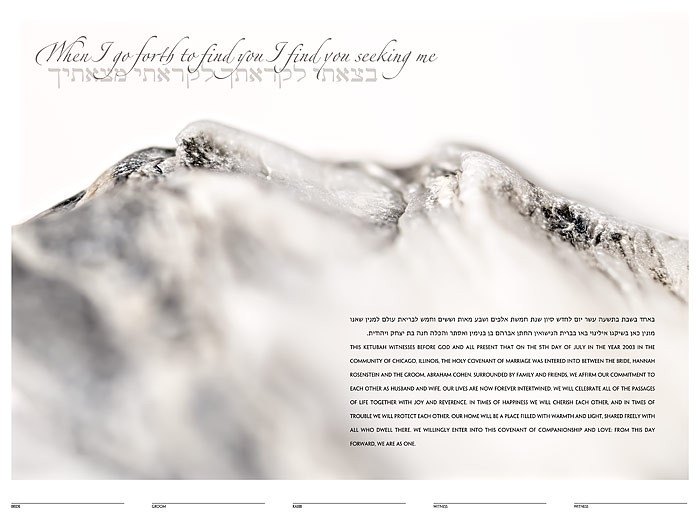
Elyssa, who purchased the Horizon Ketubah from me just wrote and asked for some advice for framing her ketubah after the ceremony. First of all, I always recommend that you take your ketubah to a local quality frame store. I don’t sell frames myself, since it’d be too expensive to ship them safely, and it would be too hard for me to provide you with the range of options your local frame shop has. Your frame store can provide you with a huge range of materials to choose from. And with their expert advice, you’ll be able to find a frame that will complement both the ketubah and your home’s decor.
Some general advice: When you get your ketubah framed, ask them to treat it like the work of art that it is. Insist that the matt be archival quality, acid-free, and non-buffered. The ketubah should be attached to the matt using art corners or cloth tape. (I do not recommend that you let them dry mount your ketubah, since this cannot be undone.) The glass or plexiglas should have the maximum UV protection available. It may cost more, but the investment will be worth it. Make sure they understand what this ketubah means to you, and that it is irreplaceable.
When chosing the materials for your frame, consider the artwork itself. For the Horizon ketubah, I’d recommend having a white or ivory matt of at least 2-3″ in width, and using a dark wood frame. Since the Horizon ketubah is a macro photograph of a dried leaf, full of tiny details and textures, I believe that the natural grain of a wood frame would bring out that texture much better than metal. A dark wood would complement the darker tones of the ketubah.
I hope this helps. And remember, after you get your framed, I’d love to see a photo of how it looks!
« see newer posts | see older posts »
|
|